
Health screenings for men ages 40 to 64
Health maintenance visit - men - ages 40 to 64; Physical exam - men - ages 40 to 64; Yearly exam - men - ages 40 to 64; Checkup - men - ages 40 to 64; Men's health - ages 40 to 64; Preventive care - men - ages 40 to 64You should visit your health care provider regularly, even if you feel healthy. The purpose of these visits is to:
- Screen for medical issues
- Assess your risk for future medical problems
- Encourage a healthy lifestyle
- Update vaccinations and other preventive care services
- Help you get to know your provider in case of an illness
Information
Even if you feel fine, you should still see your provider for regular checkups. These visits can help you avoid problems in the future. For example, the only way to find out if you have high blood pressure is to have it checked regularly. High blood sugar and high cholesterol level also may not have any symptoms in the early stages. Simple blood tests can check for these conditions.
High blood pressure
Blood pressure is a measurement of the force exerted against the walls of your arteries as your heart pumps blood to your body. Hypertension is the ...

High cholesterol
Cholesterol is a fat (also called a lipid) that your body needs to work properly. Too much bad cholesterol in your blood can increase your chance of...

There are specific times when you should see your provider or receive specific health screenings. The US Preventive Services Task Force (USPSTF) publishes a list of recommended screenings, and these are updated as needed. Below are screening guidelines for men ages 40 to 64.
BLOOD PRESSURE SCREENING
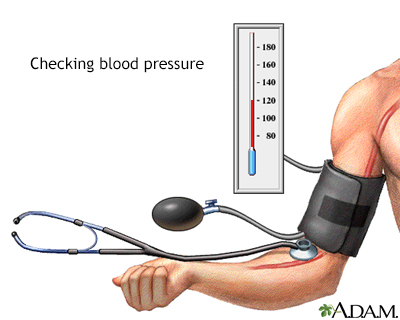
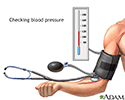
Have your blood pressure checked at least once every year. Watch for blood pressure screenings in your area. Ask your provider if you can stop in to have your blood pressure checked. You can also check your blood pressure using the automated machines at some local grocery stores and pharmacies.
Blood pressure
Blood pressure is a measurement of the force on the walls of your arteries as your heart pumps blood through your body. You can measure your blood pr...
Ask your provider if you need your blood pressure checked more often if:
- You have diabetes, heart disease, kidney problems, are overweight or have obesity, or have certain other health conditions
Diabetes
Diabetes is a long-term (chronic) disease in which the body cannot regulate the amount of sugar in the blood.
 ImageRead Article Now Book Mark Article
Heart disease
Coronary heart disease is a narrowing of the blood vessels that supply blood and oxygen to the heart. Coronary heart disease (CHD) is also called co...
 ImageRead Article Now Book Mark Article
Kidney problems
Chronic kidney disease (CKD) usually causes the slow loss of kidney function over time. The main job of the kidneys is to remove wastes and excess w...
 ImageRead Article Now Book Mark Article
 - You have a first-degree relative with high blood pressure
- You are Black
- Your blood pressure top number is from 120 to 129 mm Hg, or the bottom number is from 70 to 79 mm Hg
If the top number is 130 mm Hg or greater, but lower than 140 mm Hg, or the bottom number is 80 mm Hg or greater, but lower than 90 mm Hg, this is considered stage 1 hypertension. Readings above these are considered stage 2 hypertension. Schedule an appointment with your provider to learn how you can reduce your blood pressure. Record your blood pressure numbers and bring this information to share with your provider.
CHOLESTEROL SCREENING
The American Heart Association recommends beginning cholesterol screening at age 20 for all men with no known risk factors for coronary heart disease and repeat every 4 to 6 years.
Cholesterol screening
Cholesterol is a soft, wax-like substance found in all parts of the body. Your body needs cholesterol to work properly. But too much cholesterol ca...

Cholesterol screening should take place more often if:
- Changes occur in lifestyle (including weight gain and diet)
- You have diabetes, heart disease, kidney problems, high blood pressure, stroke, blood flow problems in the legs or feet, or certain other conditions
- Your provider recommends it because you are taking medicines to control high cholesterol
COLORECTAL CANCER SCREENING
If you are under age 45, talk to your provider about getting screened. You may need to be screened if you have a strong family history of colon cancer or polyps. Screening may also be considered if you have risk factors such as a history of inflammatory bowel disease or polyps.
Screened
Colon cancer screening can detect polyps and early cancers in the large intestine. This type of screening can find problems that can be treated befo...

If you are age 45 to 75, you should be screened for colorectal cancer. There are several screening tests available:
-
Colonoscopy every 10 years
Colonoscopy
A colonoscopy is an exam that views the inside of the colon (large intestine) and rectum, using a tool called a colonoscope. The colonoscope has a sm...
ImageRead Article Now Book Mark Article - A stool-based fecal occult blood (FOBT) or fecal immunochemical test (FIT) every year
FIT
The fecal immunochemical test (FIT) is used as a screening test for colon cancer. It tests for hidden blood in the stool, which can be an early sign...
 ImageRead Article Now Book Mark Article
 - A stool DNA test every 1 to 3 years
-
Flexible sigmoidoscopy every 5 years or every 10 years with FIT) done every year
Flexible sigmoidoscopy
Sigmoidoscopy using a flexible scope is a procedure used to see inside the sigmoid colon and rectum. The sigmoid colon is the area of the large inte...
ImageRead Article Now Book Mark Article - CT colonography (virtual colonoscopy) every 5 years
Virtual colonoscopy
A virtual colonoscopy (VC) is an imaging or x-ray test that looks for cancer, polyps, or other disease in the large intestine (colon). The medical n...
 ImageRead Article Now Book Mark Article
You may need a colonoscopy more often if you have risk factors for colorectal cancer, such as:
-
Ulcerative colitis or Crohn disease
Ulcerative colitis
Ulcerative colitis is a condition in which the lining of the large intestine (colon) and rectum become inflamed. It is a form of inflammatory bowel ...
ImageRead Article Now Book Mark ArticleCrohn disease
Crohn disease is a disease where parts of the digestive tract become inflamed. It most often involves the lower end of the small intestine and the be...
 ImageRead Article Now Book Mark Article
 - A personal or family history of colorectal cancer or polyps
Colorectal cancer
Colorectal cancer is cancer that starts in the large intestine (colon) or the rectum (end of the colon). It is also sometimes simply called colon ca...
 ImageRead Article Now Book Mark Article
Polyps
A colorectal polyp is a growth on the lining of the colon or rectum.
ImageRead Article Now Book Mark Article - A family history of inherited colorectal cancer syndromes such as familial adenomatous polyps (FAP) or hereditary nonpolyposis colorectal cancer (HNPCC)
DENTAL EXAM
- Go to the dentist once or twice every year for an exam and cleaning. Your dentist will evaluate if you have a need for more frequent visits.
PREDIABETES AND TYPE 2 DIABETES SCREENING
You should be screened for prediabetes and type 2 diabetes starting at age 35 if you are overweight or have obesity. Screening should be repeated every 3 years if you still are overweight or have obesity.
Prediabetes
Prediabetes occurs when the level of sugar (glucose) in your blood is too high, but not high enough to be called diabetes. If you have prediabetes, ...

Type 2 diabetes
Type 2 diabetes is a lifelong (chronic) disease in which there is a high level of sugar (glucose) in the blood. Type 2 diabetes is the most common f...

Screening may need to start earlier and be repeated more often if you have other risk factors for diabetes, such as:
- You have a first degree relative with diabetes
- You have high blood pressure, prediabetes, or a history of heart disease
EYE EXAM
- Have an eye exam every 2 to 4 years ages 40 to 54 and every 1 to 3 years ages 55 to 64. Your provider may recommend more frequent eye exams if you have vision problems or glaucoma risk.
Vision problems
There are many types of eye problems and vision disturbances, such as: Halos Blurred vision (the loss of sharpness of vision and the inability to see...
 ImageRead Article Now Book Mark Article
Glaucoma
Glaucoma is a group of eye conditions that can damage the optic nerve. This nerve sends the images you see to your brain. Most often, optic nerve da...
 ImageRead Article Now Book Mark Article
 - Have an eye exam that includes an examination of your retina (back of your eye) at least every year if you have diabetes.
IMMUNIZATIONS
Commonly recommended vaccines include:
-
Flu shot:
you should get one every year.
Flu shot:
All content below is taken in its entirety from the CDC Inactivated Influenza Vaccine Information Statement (VIS) www. cdc. gov/vaccines/hcp/current-...
 ImageRead Article Now Book Mark Article
 -
COVID-19 vaccine:
recommended for all people age 6 months and older. Talk with your provider about what is best for you.
COVID-19 vaccine:
COVID-19 vaccines are used to prepare the body's immune system to protect against COVID-19. Everyone ages 6 months and older should get a 2025-2026 C...
 ImageRead Article Now Book Mark Article
 -
Tetanus-diphtheria and acellular pertussis (Tdap) vaccine:
have Tdap as one of your tetanus-diphtheria vaccines if you did not receive it as an adolescent.
Tetanus-diphtheria and acellular pertus...
All content below is taken in its entirety from the Centers for Disease Control (CDC) Tdap Vaccine Information Statement (VIS): www. cdc. gov/vaccine...
 ImageRead Article Now Book Mark Article
 - Tetanus-diphtheria: have a booster (Td or Tdap) every 10 years.
-
Varicella vaccine:
receive 2 doses if you never had chickenpox or the varicella vaccine and were born in 1980 or after.
Varicella vaccine:
All content below is taken in its entirety from the CDC Chickenpox Vaccine Information Statement (VIS): www. cdc. gov/vaccines/hcp/current-vis/varice...
 ImageRead Article Now Book Mark Article
 -
Hepatitis B vaccine:
receive 2, 3, or 4 doses, depending on your exact circumstances, if you did not receive these as a child or adolescent, until age 59.
Hepatitis B vaccine:
All content below is taken in its entirety from the CDC Hepatitis B Vaccine Information Statement (VIS): www. cdc. gov/vaccines/hcp/current-vis/hepat...
ImageRead Article Now Book Mark Article -
Measles, mumps, and rubella (MMR) vaccine:
receive 1 to 2 doses if you are not already immune to MMR. Your provider can tell you if you are immune.
Measles, mumps, and rubella (MMR) vacci...
All content below is taken in its entirety from the CDC MMR (Measles, Mumps, & Rubella) Vaccine Information Statement (VIS): www. cdc. gov/vaccines/h...
ImageRead Article Now Book Mark Article - Shingles (herpes zoster) vaccine: 2 doses at or after age 50.
Ask your provider if you should receive other immunizations, especially if you have certain medical conditions, such as diabetes or are at increased risk for some diseases such as pneumonia.
INFECTIOUS DISEASE SCREENING
- All adults ages 18 to 79 should get a one-time test for hepatitis C.
Hepatitis C
Hepatitis C is a viral disease that leads to swelling (inflammation) of the liver. Other types of viral hepatitis include:Hepatitis AHepatitis BHepat...
ImageRead Article Now Book Mark Article - All people ages 15 to 65 should get a one-time test for human immunodeficiency virus (HIV).
Human immunodeficiency virus
Human immunodeficiency virus (HIV) is the virus that causes acquired immunodeficiency syndrome (AIDS). When a person becomes infected with HIV, the ...
 ImageRead Article Now Book Mark Article
 - Annual HIV screening is recommended for people at increased risk, such as being sexually active with men of unknown HIV status or having other risk factors such as injection drug use.
Depending on your lifestyle and medical history, you may need to be screened for infections such as syphilis, chlamydia, and other infections.
LUNG CANCER SCREENING
You should have an annual screening for lung cancer with low-dose computed tomography (LDCT) if:
Lung cancer
Lung cancer is cancer that starts in the lungs. The lungs are located in the chest. When you breathe, air goes through your nose, down your windpipe...

- You are age 50 to 80 years AND
- You have a 20 pack-year smoking history AND
- You currently smoke or have quit within the past 15 years
OSTEOPOROSIS SCREENING
- If you are age 50 to 69 and have risk factors for osteoporosis, you should discuss screening with your provider.
Osteoporosis
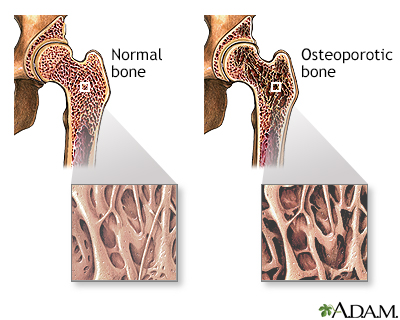
Osteoporosis is a disease in which bones become fragile and more likely to break (fracture).
 ImageRead Article Now Book Mark Article
Screening
A bone mineral density (BMD) test measures how much calcium and other types of minerals are in an area of your bone. This test helps your health care...
 ImageRead Article Now Book Mark Article
 - Risk factors can include long-term steroid use, low body weight, smoking, heavy alcohol use, having a fracture after age 50, or a family history of hip fracture or osteoporosis.
PHYSICAL EXAM
Your blood pressure, height, weight, and body mass index (BMI) should be checked at every exam.
Body mass index
A good way to decide if your weight is healthy for your height is to figure out your body mass index (BMI). You and your health care provider can us...

During your exam, your provider may ask you about:
-
Depression and anxiety
Depression
Depression may be described as feeling sad, blue, unhappy, miserable, or down in the dumps. Most of us feel this way at one time or another for shor...
 ImageRead Article Now Book Mark Article
 - Diet and exercise
- Alcohol, tobacco, and drug use
- Safety, such as use of seat belts and smoke detectors
- Your medicines and risk for interactions
PROSTATE CANCER SCREENING
If you're 55 through 69 years old, before having the test, talk to your provider about the pros and cons of having a prostate specific antigen (PSA) blood test. Ask about:
Prostate specific antigen
Prostate-specific antigen (PSA) is a protein produced by prostate cells. The PSA test is done to help screen for and monitor prostate cancer in men....

-
Whether screening decreases your chance of dying from prostate cancer
Prostate cancer
Prostate cancer is cancer that starts in the prostate gland. The prostate is a small, walnut-shaped structure that makes up part of a man's reproduc...
 ImageRead Article Now Book Mark Article
 - Whether there is any harm from prostate cancer screening, such as side effects from testing or overtreatment of cancer when discovered
- Whether you have a higher risk of prostate cancer than others
If you are younger than age 55, screening is not generally recommended. You should talk with your provider about if you have a higher risk for prostate cancer. Risk factors include:
- Having a family history of prostate cancer (especially a brother or father who were diagnosed before age 65)
- Being African American
If you choose to be tested, the PSA blood test is repeated over time (yearly or less often), though the best frequency is not known.
Prostate physical examinations are no longer routinely done on men with no symptoms.
SKIN EXAM
Your provider may check your skin for signs of skin cancer, especially if you're at high risk. You may be at high risk if you:- Have had skin cancer before
- Have close relatives with skin cancer
- Have a weakened immune system
Professional organizations do not recommend for or against performing a skin self-exam.
TESTICULAR EXAM
The USPSTF recommends against performing testicular screening. Doing testicular exams has been shown to have little to no benefit.
References
American Academy of Ophthalmology website. Clinical statement: Comprehensive adult medical eye examination PPP 2020. www.aao.org/education/preferred-practice-pattern/comprehensive-adult-medical-eye-evaluation-ppp. Updated November 2020. Accessed October 24, 2025.
American Dental Association website. Your top 9 questions about going to the dentist - answered! www.mouthhealthy.org/en/dental-care-concerns/questions-about-going-to-the-dentist. Accessed October 24, 2025.
American Diabetes Association Professional Practice Committee. 2. Diagnosis and Classification of Diabetes: Standards of Care in Diabetes-2025. Diabetes Care. 2025 Jan 1;48(1 Suppl 1):S27-S49. doi: 10.2337/dc25-S002. PMID: 39651986; PMCID: PMC11635041 pubmed.ncbi.nlm.nih.gov/39651986/.
American Heart Association website. How to get your cholesterol tested. www.heart.org/en/health-topics/cholesterol/how-to-get-your-cholesterol-tested. Last reviewed February 19, 2024. Accessed November 1, 2025.
Barton MB, Wolff TA. The preventive health visit. In: Goldman L, Cooney K, eds. Goldman-Cecil Medicine. 27th ed. Philadelphia, PA: Elsevier; 2024:chap 12.
Bushnell C, Kernan WN, Sharrief AZ, et al. 2024 Guideline for the primary prevention of stroke: a guideline from the American Heart Association/American Stroke Association. Stroke. 2024;55(12):e344-e424. PMID: 39429201 pubmed.ncbi.nlm.nih.gov/39429201/.
Centers for Disease Control and Prevention website. Vaccines & immunizations. Adult immunization schedule by age (Addendum updated June 27, 2024). Recommendations for ages 19 years or older, United States, 2024. www.cdc.gov/vaccines/hcp/imz-schedules/adult-age.html. Updated July 1, 2025. Accessed October 24, 2025.
Grundy SM, Stone NJ, Bailey AL, et al. 2018 AHA/ACC/AACVPR/AAPA/ABC/ACPM/ADA/AGS/APhA/ASPC/NLA/PCNA Guideline on the management of blood cholesterol: a report of the American College of Cardiology/American Heart Association Task Force on Clinical Practice Guidelines [published correction appears in J Am Coll Cardiol. 201925;73(24):3237-3241]. J Am Coll Cardiol. 2019;73(24):e285-e350. PMID: 30423393 pubmed.ncbi.nlm.nih.gov/30423393/.
Mora S, Libby P, Ridker PM. Primary prevention of cardiovascular disease. In: Libby P, Bonow RO, Mann DL, Tomaselli GF, Bhatt DL, Solomon SD, eds. Braunwald's Heart Disease: A Textbook of Cardiovascular Medicine. 12th ed. Philadelphia, PA: Elsevier; 2022:chap 25.
US Preventive Services Task Force website. A and B recommendations. www.uspreventiveservicestaskforce.org/uspstf/recommendation-topics/uspstf-a-and-b-recommendations. Accessed October 24, 2025.
US Preventive Services Task Force website. Final recommendation statement. Colorectal cancer: screening. www.uspreventiveservicestaskforce.org/uspstf/recommendation/colorectal-cancer-screening. Published May 18, 2021. Accessed October 24, 2025.
US Preventive Services Task Force website. Final recommendation statement. Falls prevention in community-dwelling older adults: Interventions. www.uspreventiveservicestaskforce.org/uspstf/recommendation/falls-prevention-community-dwelling-older-adults-interventions. Published June 4, 2024. Accessed October 24, 2025.
US Preventive Services Task Force website. Final recommendation statement. Hepatitis C virus infection in adolescents and adults: screening. www.uspreventiveservicestaskforce.org/uspstf/recommendation/hepatitis-c-screening. Published March 2, 2020. Accessed October 24, 2025.
US Preventive Services Task Force website. Final recommendation statement. Human immunodeficiency virus (HIV) infection: screening. www.uspreventiveservicestaskforce.org/uspstf/recommendation/human-immunodeficiency-virus-hiv-infection-screening. Published June 11, 2019. Accessed October 24, 2025.
US Preventive Services Task Force website. Final recommendation statement. Hypertension in adults: screening. www.uspreventiveservicestaskforce.org/uspstf/recommendation/hypertension-in-adults-screening. Published April 27, 2021. Accessed October 24, 2025.
US Preventive Services Task Force website. Final recommendation statement. Lung cancer: screening. www.uspreventiveservicestaskforce.org/uspstf/recommendation/lung-cancer-screening. Updated March 9, 2021. Accessed October 24, 2025.
US Preventive Services Task Force website. Final recommendation statement. Osteoporosis to prevent fracture: screening. www.uspreventiveservicestaskforce.org/uspstf/recommendation/osteoporosis-screening. Updated June 26, 2018. Accessed October 24, 2025.
US Preventive Services Task Force website. Final recommendation statement. Prediabetes and type 2 diabetes: screening. www.uspreventiveservicestaskforce.org/uspstf/recommendation/screening-for-prediabetes-and-type-2-diabetes. Updated August 24, 2021. Accessed October 24, 2025.
US Preventive Services Task Force website. Final recommendation statement. Prostate cancer: screening. www.uspreventiveservicestaskforce.org/uspstf/recommendation/prostate-cancer-screening. Updated May 8, 2018. Accessed October 24, 2025.
US Preventive Services Task Force website. Final recommendation statement. Skin cancer: screening. www.uspreventiveservicestaskforce.org/uspstf/recommendation/skin-cancer-screening. Updated April 18, 2023. Accessed October 24, 2025.
US Preventive Services Task Force website. Final recommendation statement. Testicular cancer: screening. www.uspreventiveservicestaskforce.org/uspstf/recommendation/testicular-cancer-screening. Published April 15, 2011. Accessed October 24, 2025.
Whelton PK, Carey RM, Mancia G, Kreutz R, Bundy JD, Williams B. Harmonization of the American College of Cardiology/American Heart Association and European Society of Cardiology/European Society of Hypertension Blood Pressure/Hypertension Guidelines: Comparisons, Reflections, and Recommendations. Circulation. 2022;146:868–877. DOI: 10.1161/CIRCULATIONAHA.121.054602. PMID: 35950927 pubmed.ncbi.nlm.nih.gov/35950927/.
-
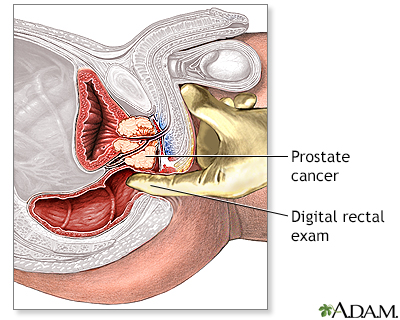
Prostate cancer - illustration
Prostate cancer is the most common cancer in men in the United States. Prostate cancer forms in the prostate gland, and can sometimes be felt on digital rectal examination. This is one of the purposes of the digital rectal exam.
Prostate cancer
illustration
-
Osteoporosis - illustration
Osteoporosis is a condition characterized by progressive loss of bone density, thinning of bone tissue and increased vulnerability to fractures. Osteoporosis may result from disease, dietary or hormonal deficiency or advanced age. Regular exercise and vitamin and mineral supplements can reduce and even reverse loss of bone density.
Osteoporosis
illustration
-
Effects of age on blood pressure - illustration
Blood vessels become less elastic with age. The average blood pressure increases from 120/70 to 150/90 and may persist slightly high even if treated. The blood vessels respond more slowly to a change in body position.
Effects of age on blood pressure
illustration
-
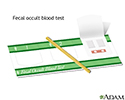
Fecal occult blood test - illustration
A fecal occult blood test is a noninvasive test that detects the presence of hidden blood in the stool. Blood in the stool that is not visible is often the first, and in many cases the only, warning sign that a person has colorectal disease, including colon cancer.
Fecal occult blood test
illustration

-
Prostate cancer - illustration
Prostate cancer is the most common cancer in men in the United States. Prostate cancer forms in the prostate gland, and can sometimes be felt on digital rectal examination. This is one of the purposes of the digital rectal exam.
Prostate cancer
illustration
-
Osteoporosis - illustration
Osteoporosis is a condition characterized by progressive loss of bone density, thinning of bone tissue and increased vulnerability to fractures. Osteoporosis may result from disease, dietary or hormonal deficiency or advanced age. Regular exercise and vitamin and mineral supplements can reduce and even reverse loss of bone density.
Osteoporosis
illustration
-
Effects of age on blood pressure - illustration
Blood vessels become less elastic with age. The average blood pressure increases from 120/70 to 150/90 and may persist slightly high even if treated. The blood vessels respond more slowly to a change in body position.
Effects of age on blood pressure
illustration
-
Fecal occult blood test - illustration
A fecal occult blood test is a noninvasive test that detects the presence of hidden blood in the stool. Blood in the stool that is not visible is often the first, and in many cases the only, warning sign that a person has colorectal disease, including colon cancer.
Fecal occult blood test
illustration
Review Date: 6/24/2025
Reviewed By: Frank D. Brodkey, MD, FCCM, Associate Professor, Section of Pulmonary and Critical Care Medicine, University of Wisconsin School of Medicine and Public Health, Madison, WI. Also reviewed by David C. Dugdale, MD, Medical Director, Brenda Conaway, Editorial Director, and the A.D.A.M. Editorial team.
 All rights reserved.